Ask an Expert: Evan Snow and Andrew Martineau share how to reduce commercial vacancy and support artists

- Issue Areas
- Housing and community development
- Outcomes
- Supportive neighborhoods

The Economic Mobility Catalog’s Strategy Guide on Commercial corridor revitalization shares best practices on measuring, rehabilitating, and reducing vacant or abandoned properties. Communities across the country are seeking solutions to revitalize commercial properties that help businesses, drive foot traffic, and create a sense of community. One promising model is Zero Empty Spaces, an organization that works with property owners and local governments to transform vacant commercial spaces into creative studios for artists and cultural hubs.
Evan Snow and Andrew Martineau are the co-founders of Zero Empty Spaces, responsible for activating 34 formerly vacant commercial spaces in five states that support over 900 artists. Evan and Andrew also lead Zero Empty Spaces’ municipal engagement, strategic growth, and tenant engagement to integrate arts and culture into urban development strategies.
In this edited Q&A, Evan and Andrew share best practices for establishing public-private partnerships, developing sustainable models for reactivating vacant space, and measuring impact.
Can you describe your work and how Zero Empty Spaces partners with local governments?
Zero Empty Spaces is a vacancy activation initiative that transforms vacant commercial properties into affordable working artist studios and community-centered creative hubs. We launched in 2019 with a simple observation: cities across the country are struggling with vacant storefronts and underutilized commercial real estate, while at the same time local artists and creative entrepreneurs are searching for affordable places to create and grow their work. We aim to bridge that gap.
Over the past seven years, Zero Empty Spaces has activated 34 formerly vacant commercial spaces across five states and welcomed more than 900 artists into the program. Our activations take place in many different environments including regional malls, downtown storefront corridors, office campuses, and mixed-use districts. Beyond redevelopment, we support local governments in placemaking – that is, reimagining or reinventing public spaces – by creating unique, creative spaces for communities.
Many cities have strong plans for revitalization, but translating those plans into operational programs can be difficult due to capacity or funding limitations. When we partner with local governments, we typically serve as the implementation partner that brings vacancy activation strategies to life. In practice, this means recruiting artists, managing studio operations, coordinating programming, working with property owners, and ensuring that the space remains active and vibrant. Cities benefit from immediate corridor activation, increased foot traffic to nearby businesses, and cultural programming, while artists gain access to affordable workspace and a supportive creative ecosystem.
How can creative placemaking contribute to a city’s broader community development strategy?
Creative placemaking, and now “interior placemaking,” can change how a corridor feels almost overnight.
When artists are actively working in storefront studios, people stop, explore, and engage. What was once an empty or overlooked space becomes a destination. That energy spreads quickly to surrounding businesses and public spaces.
Our studios operate as working creative environments where artists are creating, teaching, collaborating, and interacting with the public. Many locations host open studios, workshops, community classes, and nonprofit events that draw residents and visitors into the corridor. Beyond the cultural impact, artists also function as early-stage entrepreneurs. Many artists in our program build businesses around their work through commissions, classes, and sales. In that way, these spaces can become small business incubators that support the broader economic health of a district.
When integrated into a city’s development strategy, creative placemaking helps strengthen neighborhood identity, increase walkability, and bring consistent activity back to commercial corridors that may have struggled with vacancy.
When artists are actively working in storefront studios, people stop, explore, and engage. What was once an empty or overlooked space becomes a destination. That energy spreads quickly to surrounding businesses and public spaces.
How can cities best structure public-private partnerships to address commercial vacancy?
The most effective public-private partnerships around vacancy activation start with establishing shared priorities and identifying clear operational leadership.
Property owners want activity in their spaces and positive visibility while they work to secure long-term tenants. Cities want vibrant commercial corridors, increased foot traffic, and support for local entrepreneurs. When those interests are aligned, vacancy becomes an opportunity rather than a liability.
We have also learned that activation programs succeed when there is a dedicated operator responsible for implementation. Vacancy activation is not simply a policy concept. It requires day-to-day management, artist recruitment, programming, and relationship building.
With a dedicated team or operating partner to manage implementation, local leaders can focus on aligning stakeholders, supporting permitting or policy frameworks, and integrating activation into broader development strategies. This structure allows cities to move quickly and confidently while ensuring that the program delivers meaningful results on the ground.
How can activation programs be designed to be durable and self-sustaining?
We have learned that activation works best as a system of incentives. In our case, we created a system that creates value for artists, property owners, and the surrounding community.
Artists benefit by gaining access to affordable studios where they can work and grow their creative businesses. Property owners benefit from increased visibility, community goodwill, and an active environment that makes their property more attractive to future tenants. The community benefits from cultural programming and opportunities to engage with local creatives.
We create incentives for property owners by providing complimentary vacancy management solutions while helping support their leasing activity, in exchange for a $0 lease structure while the property remains vacant and available for activation. Artists pay affordable monthly studio fees that cover utilities and operational costs, which allows the program to sustain core operations while still creating a low-barrier pathway for cities, property owners, and artists to participate.
We also build strong creative communities within each location. Artists collaborate, share audiences, and contribute to programming that keeps the space active. Over time, these studios become creative ecosystems that continue generating value for the surrounding corridor.
Activation works best as a system of incentives. In our case, we created a system that creates value for artists, property owners, and the surrounding community.
How do you measure the effects of your work on small business incubation and the overall health of a commercial corridor?
We track both program-level and community-level indicators.
At the program level, we measure metrics such as artist participation, studio occupancy rates, waiting lists, programming frequency, and the number of events or classes hosted within the space. We also follow artist outcomes including exhibitions, commissions, teaching opportunities, and the growth of creative businesses that begin within our studios. Artists are also encouraged to report sales and income so we can better capture real-world economic impact, alongside our own local spending through vendors, city fees, and other operating expenses.
On the corridor level, property owners and city partners frequently report increased foot traffic, improved perception of previously vacant areas, and stronger engagement with neighboring businesses.
While every corridor is unique, the consistent pattern we see is that once creative activity begins, it helps restore momentum. People start returning to spaces that once felt inactive, which in turn encourages further investment and leasing activity.
Property owners and city partners frequently report increased foot traffic, improved perception of previously vacant areas, and stronger engagement with neighboring businesses.
What advice would you give to a community currently looking at a high-vacancy corridor but unsure of where to start?
The most important shift is to view vacancy as a platform for experimentation rather than simply a problem to solve.
Communities should begin by identifying a cluster of vacant spaces where activation could quickly create visible momentum. Even a handful of active spaces can change how people experience a corridor.
Equally important is engaging with stakeholders and following through on space activation. Successful programs require consistent coordination, artist engagement, programming, and communication. Having a team or organization responsible for the day-to-day operations ensures the initiative doesn’t lose momentum.
Finally, communities should think about vacancy activation as a strategy rather than a one-time project. When multiple spaces activate together and remain consistently programmed, they begin to form a network of creative activity that draws people back into the district. That is where the real transformation begins to happen.
Contributors
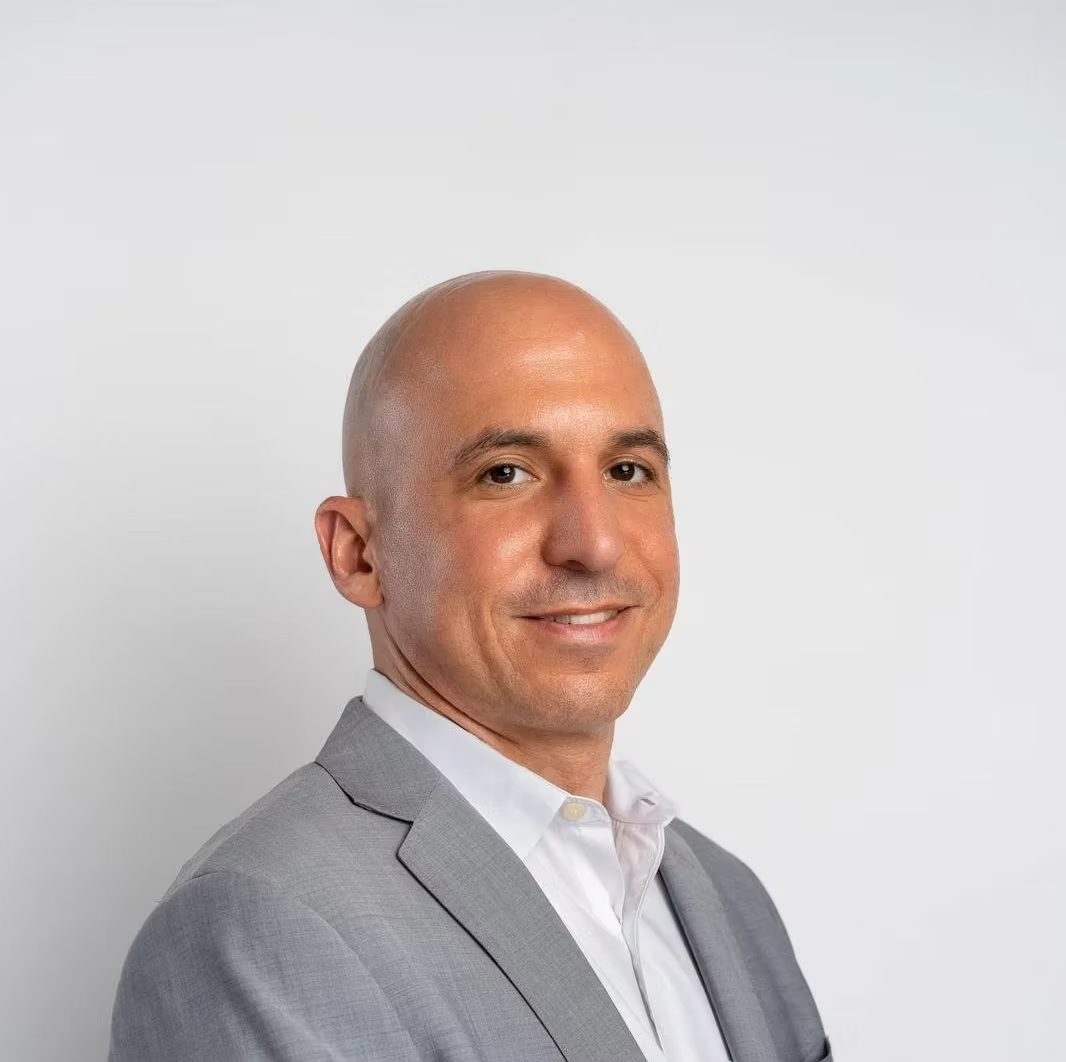
Evan Snow
Evan Snow is the Co-Founder of Zero Empty Spaces, where he drives strategic growth and partnerships to transform vacant commercial properties into affordable artist studios and cultural hubs. He focuses on business development, tenant engagement, municipal engagement, and program expansion, ensuring the model delivers sustainable value for property owners, public-sector partners, and creative entrepreneurs.
Since co-founding Zero Empty Spaces in 2019, Evan has been instrumental in scaling the initiative to 34 locations across five states, creating a repeatable framework that activates underutilized real estate while generating measurable cultural and economic impact. His leadership builds on his experience as a cultural entrepreneur and community advocate, specializing in launching ventures that connect artists, audiences, and institutions.
In addition to Zero Empty Spaces, Evan is the Co-Founder of Choose954, a social movement dedicated to cultivating culture and community in Greater Fort Lauderdale, and Co-Founder of Art Fort Lauderdale, an immersive “art fair on the water” recognized for reimagining how audiences engage with contemporary art. He frequently collaborates with municipalities, developers, and civic organizations to integrate arts and culture into urban development strategies.

Andrew Martineau
Andrew Martineau is the Co-Founder and Managing Partner of Zero Empty Spaces. He leads the company’s strategy to activate vacant commercial properties into productive, revenue-generating assets through scalable creative reuse models. Andrew oversees site acquisition, negotiations with property owners, and all marketing, public relations, and event programming, ensuring consistent outcomes for municipal and private-sector partners.
Since co-founding Zero Empty Spaces in 2019, Andrew has grown the initiative into a multi-city platform that delivers measurable community and economic returns. His leadership builds on more than two decades in commercial real estate marketing, including Marketing and Business Development roles for Westfield Group, where he led branding and activation strategies for a $40M property renovation of one of their South Florida properties and developed programs that consistently drove sales and traffic growth.
Alongside his work at Zero Empty Spaces, Andrew is CEO of UniteUs Group, where he consults on branding and marketing strategy for destinations, cultural institutions, and businesses. He is also an active community leader, having served on numerous boards and advisory councils, and is recognized with multiple awards for his creative achievements and contributions to arts, culture, and civic life.